
A worker steps onto a flat roof to clear a clogged drain. No harness, no guardrail, no anchor point—because it was “only going to take a minute.” The fall is eleven feet onto concrete. Now you have an ambulance in the parking lot, an OSHA inspector on the way, and a workers’ compensation claim that will follow your business for the next three years.
Falls aren’t a freak event. They are the single most-cited safety failure in the country. Fall Protection has been OSHA’s number-one most frequently cited standard for fifteen years running, with 5,914 violations in fiscal year 2025 alone—and fall protection training landed at number six on that same list. Two of OSHA’s ten most-cited standards are about falls.
The part most owners miss is what happens after the injury. The medical bill is only the opening cost. A serious claim raises your Experience Modification Rate, and that higher rate quietly inflates your workers’ compensation premium for years. Fall protection training isn’t a box to check for OSHA. It’s one of the cheapest ways to protect both your people and your bottom line.
Table of Contents
- When Is Fall Protection Required?
- The Real Cost of a Single Fall
- What OSHA Requires: The Standards Behind the Citations
- The Types of Fall Protection
- What Fall Protection Training Actually Requires
- How to Build a Fall Protection Plan
- Making It Manageable
- The Bottom Line
- FAQs
When Is Fall Protection Required?
The threshold depends on the kind of work you do, and the numbers are not the same across industries. OSHA sets three you need to know:
- General industry: 4 feet. Under 29 CFR 1910.28, any employee on a walking-working surface with an unprotected side or edge 4 feet or more above a lower level must be protected from falling.
- Construction: 6 feet. Under 29 CFR 1926.501, fall protection is required at 6 feet or more above a lower level.
- Scaffolds: 10 feet. Under 29 CFR 1926.451, fall protection is required for any employee more than 10 feet above a lower level.
If your team works on roofs, ladders, scaffolds, mezzanines, elevated platforms, loading docks, or near floor openings, you are almost certainly in scope. The reason these thresholds matter is simple: the height where the law kicks in is far lower than most owners assume. A worker on a 5-foot platform in a warehouse is already past the general-industry line.
When in doubt, treat the lower threshold as your standard. Protecting a worker at 4 feet costs you almost nothing. Not protecting them is what shows up on an OSHA citation and a comp claim.
The Real Cost of a Single Fall
Falls are expensive in a way that doesn’t end when the worker heals. According to the Liberty Mutual 2025 Workplace Safety Index, falls on the same level cost American employers $10.5 billion a year and falls to a lower level cost another $5.8 billion—roughly $16 billion combined, and close to a third of the entire national bill for serious workplace injuries.
For a single business, the direct costs of one fall—emergency care, surgery, lost wages, a replacement worker, the investigation—routinely run into the tens of thousands, and serious falls can reach hundreds of thousands. But the direct bill is only part of the equation. The part that lingers is the effect on your Experience Modification Rate (EMR).
Here is the mechanism most owners never have explained to them. Your EMR compares your claims history to other businesses of your size in your industry. A 1.0 is average. Above 1.0, you pay a surcharge on your premium; below 1.0, you earn a discount. Workers’ compensation rating in most states is built by NCCI on a three-year window of claims—and it deliberately leaves out your most recent year. That means a claim filed today doesn’t fully hit your mod for a year or two, and then it stays baked in for about three years after that.
The math is straightforward and unforgiving. Say your base premium is $100,000 a year. A fall claim helps push your EMR from 1.0 to 1.3. That’s an extra $30,000 a year—and because the experience period spans three years, you’re looking at roughly $90,000 in added premium from a single preventable injury. One fall. Three years. And the rating plan weights claim frequency more heavily than severity, so even a moderate fall claim moves the needle.
Compare that to the cost of prevention. OSHA’s own Safety Pays data estimates employers save $4 to $6 for every $1 invested in safety programs. Fall protection training sits at the very top of that return.
What OSHA Requires: The Standards Behind the Citations
Under OSHA’s General Duty Clause, every employer must provide a workplace free of recognized hazards—and a fall from height is the textbook example of a recognized hazard. On top of that general duty, OSHA writes specific fall-protection requirements into both the general industry (1910) and construction (1926) standards.
The enforcement numbers show how seriously this is treated. Fall Protection – General Requirements (1926.501) was the most-cited OSHA standard in fiscal 2025 for the fifteenth consecutive year, at 5,914 violations. Fall Protection – Training Requirements (1926.503) was sixth, at 1,907. When a quarter of OSHA’s most-cited standards are about falls, it tells you exactly where inspectors look first.
The financial exposure compounds. A serious OSHA violation can cost well over $16,000 per instance, and willful or repeated violations climb into the six figures. But as with everything in safety, the citation is rarely the real cost—the claim that follows the injury is. An untrained worker who falls generates a citation and a comp claim and an EMR increase, all at once.
Falls remain the leading cause of death in construction. In 2024, the Bureau of Labor Statistics counted 844 fatal falls, slips, and trips across all industries, and in construction, 95.9% of fall-related deaths were falls to a lower level. These are not paperwork problems. They are the difference between a worker going home or not.
The Types of Fall Protection
A fall protection program isn’t one device—it’s a hierarchy of controls. As an employer, you’re responsible for selecting and providing the right protection for each task. The main categories:
Guardrails and passive systems. A guardrail, a covered floor opening, or a barricade stops a fall without the worker having to do anything. Passive systems are the most reliable because they don’t depend on a person remembering to clip in.
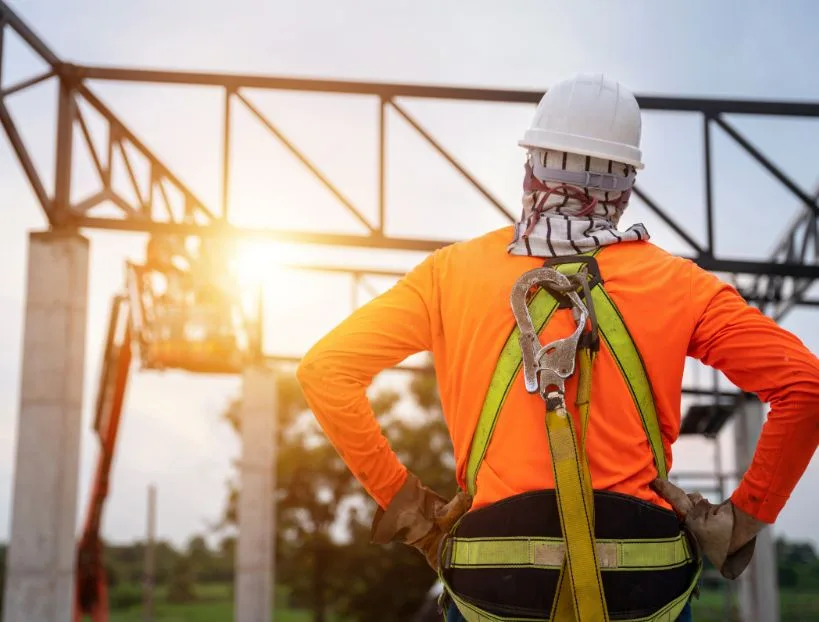
Personal fall arrest systems (PFAS). When passive protection isn’t feasible, workers wear a full-body harness connected to a secure anchor point by a lanyard or a self-retracting lifeline. A PFAS doesn’t prevent the fall—it stops it safely before the worker hits a lower level. Every piece has to be rated, inspected, and worn correctly to work.
Anchor points. The anchor is what everything else connects to, and it has to be strong enough to hold a falling worker—an under-rated or improvised anchor is a common and dangerous failure.
A quick note on equipment, since it’s a frequent question: a lanyard is a fixed-length connector, while a self-retracting lifeline (SRL) works like a seatbelt—it lets the worker move freely but locks instantly when a fall begins, which shortens the fall distance. Choosing between them depends on the work and the available clearance below. Your job as the employer isn’t to become a gear expert; it’s to make sure the right system is provided, inspected, and that every worker knows how to use it. That last part—knowing how to use it—is training.
What Fall Protection Training Actually Requires
This is where most programs quietly fail. Owning harnesses and writing a policy means nothing if your people haven’t been trained to recognize the hazard and use the equipment. OSHA makes the training requirement explicit.
Under 29 CFR 1926.503, employers must provide a fall protection training program for each employee who might be exposed to fall hazards, and it must be delivered by a competent person. The training has to cover the nature of the fall hazards in the work area, the correct procedures for using fall protection systems, and the details of your own fall protection plan.
The approach we always recommend is to split that into two parts. Let the Smarter Risk Training Director handle the classroom portion—the fundamentals every worker needs: the types of fall hazards, how fall protection systems work, and the rules that apply. Then have your competent person cover the site-specific half in person: your actual equipment, your anchor points, your roof or platform, and the particular hazards of your job. The online course gives everyone the same documented foundation; your competent person makes it real for your worksite. Together, they satisfy the standard and actually prepare the worker—instead of just checking a box.
Training isn’t a one-and-done certificate, either. The standard requires retraining whenever workplace changes make previous training obsolete, whenever the equipment or systems change, or whenever a worker shows—through their actions—that they haven’t retained the knowledge or skill. In plain terms: if someone is using a harness wrong, you’re required to retrain them, and you’d want to anyway.
Here’s the trap to avoid. “We held a toolbox talk about ladders once” is not documented fall protection training, and it won’t satisfy an OSHA inspector or your insurance carrier after a claim. What protects you is a real program with real records: who was trained, on what, by whom, and when. Effective fall protection training combines clear instruction on hazards and equipment with documentation you can produce on demand. Without that paper trail, your EMR goes up after a fall whether or not the worker “knew better.”
Working at heights is one of the highest-risk tasks your team performs. It deserves training that’s specific, repeatable, and recorded—not a verbal reminder before the job starts.
How to Build a Fall Protection Plan
A fall protection plan turns scattered safety habits into a documented program OSHA and your insurer will recognize. It doesn’t require a safety department—it requires a systematic approach:
1. Assess the hazards. Walk your operation and identify every place a worker could fall 4 or 6 feet or more—roofs, ladders, platforms, docks, openings. Write them down. You can’t control a hazard you haven’t named.
2. Choose your controls. For each hazard, pick the highest-level protection that’s feasible: guardrails first, then personal fall arrest systems where passive protection isn’t possible. Specify the equipment and the anchor points.
3. Train every exposed employee. Deliver fall protection training, by a competent person, before anyone works at height—covering the hazards, the equipment, and this plan.
4. Document everything. Keep training records, inspection logs for harnesses and anchors, and signed acknowledgments. Documentation is what turns “we’re careful” into “we’re compliant.”
5. Review and retrain. Update the plan when the work changes, re-inspect equipment on schedule, and retrain when conditions or behavior call for it.
A written plan is also your safety orientation backbone for new hires. The day someone joins, they should learn your fall hazards and protections before they ever step onto a ladder.
Making It Manageable
The reason most small businesses don’t have a complete fall protection program isn’t that they don’t care—it’s time. Writing a policy from scratch, building training, and tracking records feels like a second job. It doesn’t have to be.
Smarter Risk is built to remove that friction. Our Policy Builder generates a custom, OSHA-aligned working-at-heights policy in minutes—you answer a few questions about your operation, and it produces a written fall protection plan you can actually use and hand to an inspector. No consultant, no blank page.
For the training itself, the Training Director library includes fall protection and working-at-heights courses alongside more than fifty other OSHA-aligned topics, with unlimited seats and automatic completion records. Employees finish a course on their own schedule, and the documentation—who was trained, on what, when—is captured and stored for you. That’s the paper trail that protects your EMR after an incident.
And before you build anything, a free 15-minute risk assessment will show you exactly where your hazards and training gaps are, so you fix the right things first. The whole point is to get a defensible fall protection program standing in days, not months—at a fraction of the cost of one claim.
The Bottom Line
Falls are the most-cited, most-fatal hazard in American workplaces, and they’re among the most preventable. The businesses with the lowest claims and the best insurance terms aren’t lucky—they’ve systematically removed fall hazards, trained every exposed worker, and documented all of it.
The financial case is just as clear as the safety case. One serious fall sends a claim into your three-year experience window, pushes your EMR up, and inflates your premium long after the worker has recovered. Fall protection training—paired with a written plan and real records—is what breaks that cycle before it starts.
The most cost-effective time to prevent a fall is before it happens. Identify your fall hazards, put the right protection in place, train your people, and document it. Your workers will go home safe, and your EMR will reflect the investment for years.
Ready to protect your team and your premiums?
- Take a free 15-minute risk assessment to find your hazards and training gaps. Start here. When your assessment is complete, that will open up your dashboard so you can build safety programs and assign training.
- Build your working-at-heights policy in minutes with Policy Builder
- Access fall protection training and 50+ OSHA-aligned courses with unlimited seats
Sources
- OSHA, “Top 10 Most Frequently Cited Standards” (FY2025) - https://www.osha.gov/top10citedstandards
- National Safety Council, “OSHA Reveals Top 10 Safety Violations at NSC Congress” (2025) - https://www.nsc.org/newsroom/osha-reveals-top-10-safety-violations-at-nsc-congr
- Liberty Mutual, “2025 Workplace Safety Index” - https://business.libertymutual.com/insights/2024-workplace-safety-index/
- U.S. Bureau of Labor Statistics, “Census of Fatal Occupational Injuries, 2024” - https://www.bls.gov/news.release/pdf/cfoi.pdf
- OSHA, 29 CFR 1910.28 (General industry fall protection) - https://www.osha.gov/laws-regs/regulations/standardnumber/1910/1910.28
- OSHA, 29 CFR 1926.501 (Construction fall protection) - https://www.osha.gov/laws-regs/regulations/standardnumber/1926/1926.501
- OSHA, 29 CFR 1926.503 (Fall protection training requirements) - https://www.osha.gov/laws-regs/regulations/standardnumber/1926/1926.503
- OSHA, “Safety Pays Program” - https://www.osha.gov/safetypays
- NCCI, “ABCs of Experience Rating” - https://www.ncci.com/articles/documents/uw_abc_exp_rating.pdf
Frequently Asked Questions
When is fall protection required? Fall protection is required whenever an employee is exposed to a fall from a certain height: 4 feet in general industry, 6 feet in construction, and 10 feet on scaffolds. It also applies near unprotected floor openings and dangerous equipment regardless of height. If your team works on roofs, ladders, platforms, or docks, you are almost certainly in scope.
At what height does OSHA require fall protection? It depends on the standard that applies to your work. OSHA requires fall protection at 4 feet in general industry (29 CFR 1910.28), 6 feet in construction (29 CFR 1926.501), and 10 feet on scaffolds (29 CFR 1926.451). When in doubt, use the lower threshold as your standard.
How often is fall protection training required? There is no fixed annual interval, but OSHA (29 CFR 1926.503) requires retraining whenever workplace changes make previous training obsolete, when equipment or systems change, or when a worker demonstrates they haven’t retained the required knowledge or skill. Many employers train at hire and refresh annually as a best practice.
What are the types of fall protection? The main categories are passive systems (guardrails, covers, and barricades), personal fall arrest systems (a full-body harness, lanyard or self-retracting lifeline, and anchor point), and positioning or restraint systems. Passive guardrails are generally preferred because they don’t depend on a worker remembering to clip in.
What’s the difference between a lanyard and a self-retracting lifeline? A lanyard is a fixed-length connector between the harness and the anchor. A self-retracting lifeline (SRL) works like a seatbelt—it extends and retracts as the worker moves but locks instantly when a fall begins, which shortens the fall distance. The right choice depends on the task and the clearance available below the worker.
Does a fall claim raise my workers’ comp insurance? Yes. A serious fall claim raises your Experience Modification Rate (EMR), which increases your workers’ compensation premium. Because rating is based on a roughly three-year window of claims, the cost of a single fall can stay in your premium for years after the injury.
What should my fall protection documentation include? Complete fall protection documentation includes a list of the fall hazards in your operation, the controls and equipment chosen for each, training records for every exposed worker, inspection logs for harnesses and anchors, and signed acknowledgments—all reviewed and updated whenever the work changes. A written plan is what turns good intentions into OSHA-recognized compliance.
Who can provide fall protection training? OSHA requires that fall protection training be delivered by a “competent person”—someone capable of identifying fall hazards and authorized to correct them. Online courses can deliver the foundational knowledge and documentation, paired with site-specific, hands-on instruction on your actual equipment and anchor points.
Internal Resources
Policy Builder
Generate a custom, OSHA-aligned working-at-heights policy in minutes—no consultant or blank page required.Training Director - Fall Protection & 50+ Courses
Access online fall protection and working-at-heights training with unlimited seats and automatic completion records.Free Risk Assessment
Take a 15-minute assessment to pinpoint your fall hazards and training gaps and get a customized improvement plan.Safety ROI Calculator
Calculate the savings from preventing falls and reducing workers’ compensation claims.OSHA Recordable Injury Classifier
Determine whether a fall injury is OSHA recordable and understand your reporting obligations.
External Resources
OSHA Fall Protection
Official OSHA hub for fall protection standards, requirements, and prevention resources.OSHA Safety Pays Program
Estimate the direct and indirect costs of a fall injury and the ROI of preventing it.
Related Resources
Blog Posts
Workers’ Compensation Experience Modification Rate: The #1 Strategy to Lower Your Costs
Learn exactly how your EMR is calculated and the top strategy for bringing it down.Understanding Your Experience Modification Rate: The Complete Guide
A plain-language breakdown of the experience modifier and how a single claim drives up your premiums for years.5 Steps to Reduce Workers’ Compensation Costs With a Return-to-Work Program
Practical strategies to cut claims, return injured workers safely, and lower your premiums.
Toolbox Talks
Preventing Falls From Heights
A ready-to-use talk on recognizing fall hazards and using protection correctly.Guardrails and Fall Protection Basics
Cover the fundamentals of passive and active fall protection with your crew.Fall Prevention Strategies
Practical, jobsite-ready strategies to keep workers safe at height.
Related Training
Working at Heights
Online training covering fall hazards, fall protection systems, and safe work at elevation.Ladder Safety
Essential training on selecting, inspecting, and safely using ladders—a leading source of falls.
About the Author

John Morlan
Founder & CEO, Smarter Risk
John Morlan is the founder of Smarter Risk, a platform helping small businesses implement practical safety and risk control programs. With years of experience in workers' compensation and risk management, John has helped businesses reduce their risk and save on insurance costs through proactive risk control and safety strategies.
Put this into practice. Take our free 15-minute assessment and SmarterRisk builds your safety program, training, and Risk Report automatically.
Start your free assessment