
Build an OSHA-aligned safety program, train your team on the machine hazards that cause amputations and crushes, and document it all — in one platform. No safety manager required.
A 15-minute AI-assisted assessment finds your hazards, policy gaps, and training needs — with a prioritized action plan.
Generate OSHA-aligned safety programs and policies for your plant — in a few clicks, no consultant required.
50+ courses including Machine Guarding, Lockout/Tagout, and Hazard Communication — assign, track, and document with unlimited seats.
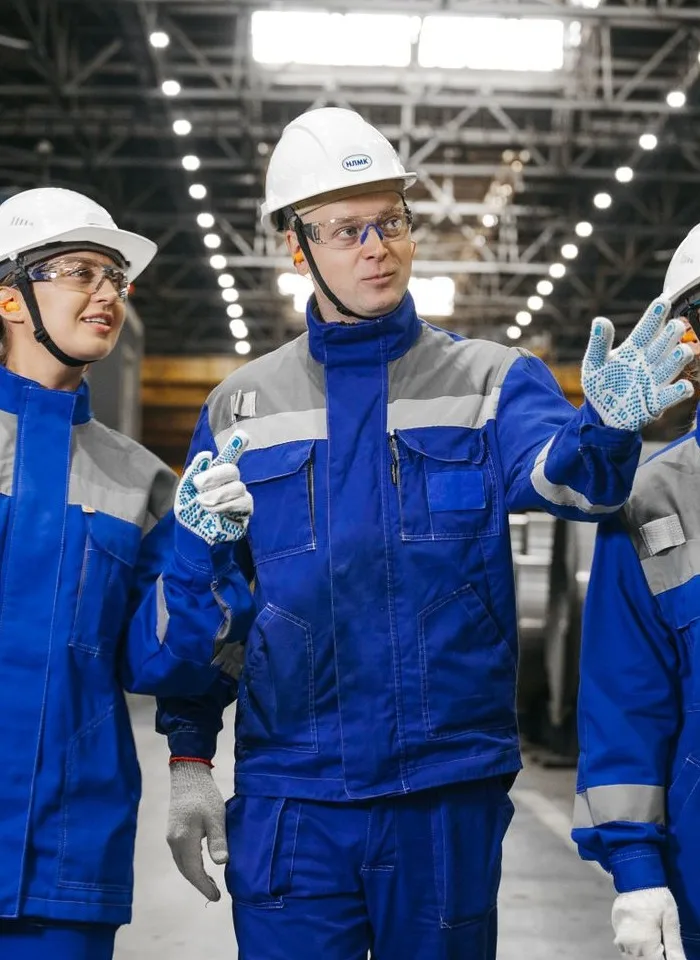
Manufacturing runs on powerful machinery, moving equipment, and constant material handling — and the injury numbers land above the private-industry average.
Sources: U.S. Bureau of Labor Statistics — Survey of Occupational Injuries & Illnesses (2023) and Census of Fatal Occupational Injuries (2022); OSHA Machine Guarding eTool; CDC/NIOSH Machine Safety.
The same handful of hazards drives most manufacturing injuries. Here’s what to watch — and what your safety program has to cover.
Missing or defeated machine guards cause crushing and amputation injuries at the point of operation — the single biggest hazard on the plant floor.
Machines that start up during maintenance without proper lockout/tagout can crush or electrocute the worker servicing them.
Forklifts moving through crowded aisles strike pedestrians, tip over, and drop loads when operators cut corners.
Falling stock, moving parts, and conveyor pinch points strike and pull in workers who get too close.
Repetitive lifting, awkward postures, and heavy manual handling drive the sprains and strains that fill days-away-from-work logs.
Oil, coolant, and cluttered walkways on the plant floor put workers on the ground with sprains, fractures, and head injuries.
A plant floor concentrates the most dangerous parts of industrial work in one place: powerful machinery with exposed points of operation, stored energy waiting to release during maintenance, forklifts weaving between people, and constant material handling. That mix is why manufacturing’s recordable injury rate — 2.8 per 100 workers in 2023 — runs above the private-industry average, according to the U.S. Bureau of Labor Statistics. The broader worlds of industrial safety and plant safety wrestle with the same physics: machines that don’t forgive a moment of inattention.
The encouraging part is that manufacturing injuries are predictable, and predictable means preventable. The same hazards — unguarded machinery, hazardous energy, forklifts, struck-by and caught-in events, ergonomics, and slips — show up in incident logs again and again. A structured safety program targets exactly those risks, which is why plants that run one see dramatically fewer claims.
There is no single “manufacturing safety standard.” Instead, plants have to meet several OSHA requirements at once:
Keeping all of that straight is the part most small manufacturers struggle with. SmarterRisk’s Safety Program Builder generates OSHA-aligned policies in a few clicks, so nothing falls through the cracks.
Machinery is the signature manufacturing hazard. About half of all workplace amputations happen in this sector, with stationary and portable machinery the primary cause — and contact-with-objects-and-equipment events (struck-by, caught-in, machinery) caused 106,000 nonfatal injuries and 738 deaths in a single year across industries. Two controls do most of the work: guarding every point of operation, and locking out energy before anyone reaches in.
Guards keep hands out of presses, saws, and rollers. Lockout/tagout keeps a machine from starting up while it’s being serviced — the failure that crushes or electrocutes maintenance workers. SmarterRisk’s Machine Guarding course and Lockout/Tagout course train your team on both, and log each employee’s completion so you can prove it.
Use this as a starting point for a walk of your plant floor:
SmarterRisk turns a walk like this into a scored assessment with a prioritized action plan — a living record you can act on and share, instead of a paper checklist in a drawer.
Most small manufacturers don’t have a safety manager, and traditional consultants cost thousands. That’s the gap SmarterRisk closes. In about 15 minutes, an AI-assisted assessment identifies your specific hazards, generates your OSHA-aligned policies, assigns the right training from a library of 50+ courses, and documents your controls with photo verification. Your safety score updates in real time, and a one-click Risk Report shows your agent and carrier that you’re actively managing risk — the very thing that lowers your workers’ comp costs over time.
Safety isn’t just a compliance box. OSHA estimates employers save $4–$6 for every $1 spent on it, and a landmark Ohio Bureau of Workers’ Compensation study found structured programs cut claim costs by over 80%. For a plant running on thin margins, that’s the difference between one bad year that follows you for three — and a floor where everyone goes home safe. Run your numbers or start a free assessment to see where you stand.
Everything a manufacturer needs to prevent injuries and prove it — without hiring a safety manager.
A 15-minute AI-assisted assessment finds your hazards, policy gaps, and training needs, then builds a prioritized action plan.
Generate the OSHA-aligned safety programs and policies your plant needs — in a few clicks, no consultant required.
Assign Machine Guarding, Lockout/Tagout, Forklift Safety, Hazard Communication, and 50+ more courses. Track completion and document it.
Photo-verify controls, watch your safety score rise, and export a Risk Report your carrier recognizes.
Your Intelligent Plan covers the whole safety program — for less than the cost of one injury.
Unguarded machinery, hazardous energy during maintenance (lockout/tagout), forklift traffic, being struck by or caught in moving parts and falling stock, ergonomic overexertion, and slips on oily floors are the big ones. Machinery is the signature hazard — about half of all workplace amputations happen in manufacturing.
There is no single ‘manufacturing’ standard — plants fall under several: Machine Guarding (1910.212), Lockout/Tagout (1910.147), Powered Industrial Trucks (1910.178), Hazard Communication (1910.1200), PPE (1910.132), Walking-Working Surfaces (1910.22), and Emergency Action Plans (1910.38), among others. SmarterRisk’s program builder generates OSHA-aligned policies that cover them.
Assess your hazards, write the required policies, train your team, and document everything. SmarterRisk does all four in one place — a 15-minute assessment, one-click OSHA-aligned policies, 50+ training courses, and a shareable Risk Report.
Machine guards in place at every point of operation, lockout/tagout procedures and locks for each machine, certified forklift operators and marked lanes, chemical labeling and safety data sheets (HazCom), clear aisles and clean floors, PPE, and current training records for every employee. SmarterRisk turns that walk into a scored assessment with an action plan.
Rotate through machine guarding, lockout/tagout, forklift and pedestrian safety, safe lifting and ergonomics, housekeeping, Hazard Communication, and near-miss reporting. SmarterRisk’s Training Director includes short courses on each so you can assign, discuss, and document them.
Guard every machine, lock out energy before maintenance, train and certify forklift operators, fix ergonomic and housekeeping hazards, and keep documented training current. OSHA estimates $4–$6 saved for every $1 spent on safety, and a landmark Ohio BWC study found structured programs cut claim costs by over 80%. Try the Safety ROI Calculator.
Run a free 15-minute assessment, build your OSHA-aligned program, and train your team. No credit card, no safety manager required.