
Build an OSHA-aligned safety program, train your team on the cuts, burns, and slips that put people in the ER, and document it all — in one platform. No safety manager required.
A 15-minute AI-assisted assessment finds your hazards, policy gaps, and training needs — with a prioritized action plan.
Generate OSHA-aligned safety programs and policies for your restaurant — in a few clicks, no consultant required.
50+ courses including Restaurant Safety, Slips & Falls, and Hazard Communication — assign, track, and document with unlimited seats.
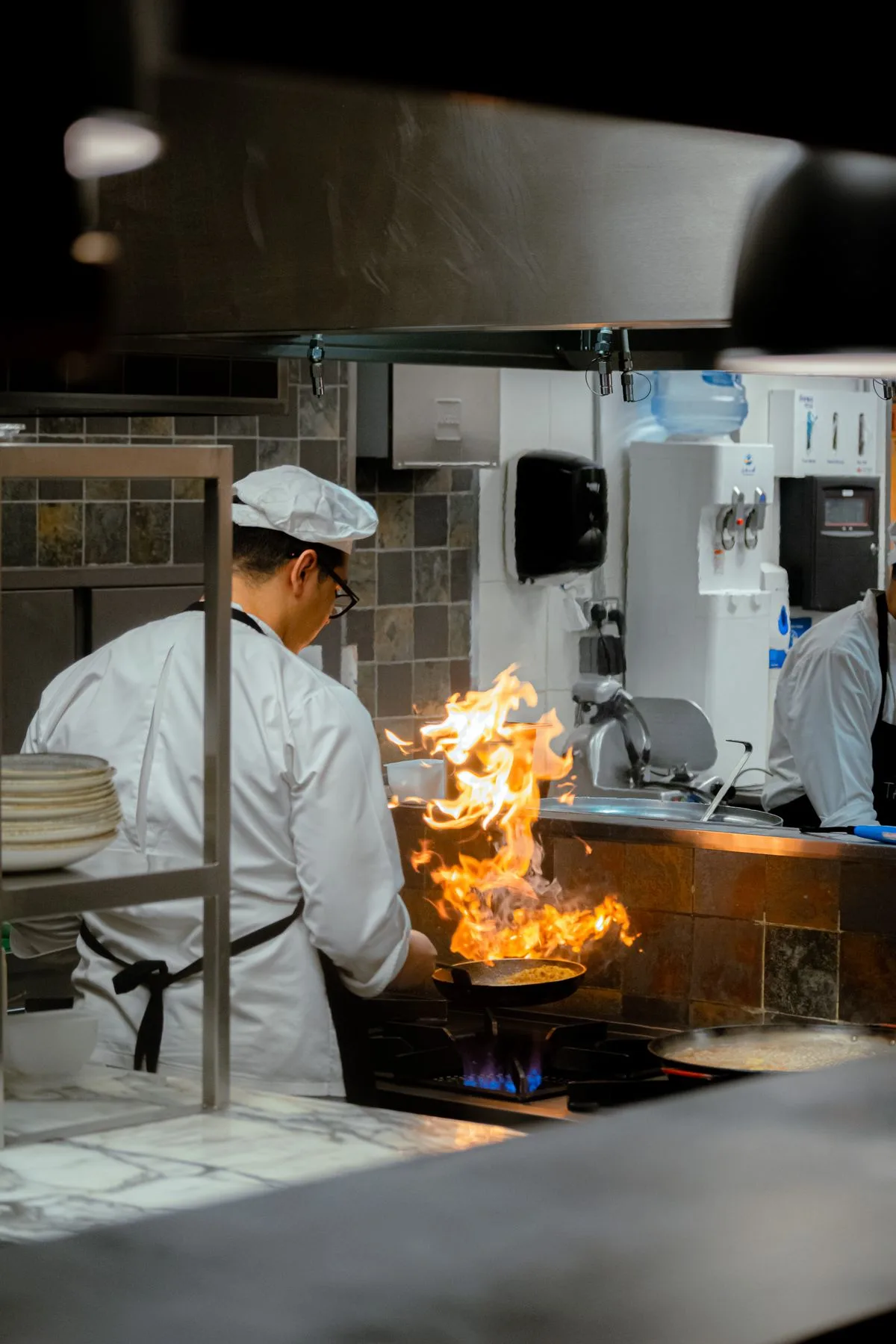
Restaurants run hot, fast, and wet — and cuts, burns, and slips add up quickly, especially among the young workers kitchens rely on.
Sources: NIOSH research on injuries to young restaurant workers; U.S. Bureau of Labor Statistics; OSHA.
The same handful of hazards drives most kitchen injuries. Here’s what to watch — and what your safety program has to cover.
Grills, fryers, and hot oil cause the burns that define kitchen injuries. Splash guards, dry handling, and hot-oil procedures prevent them.
Knives, slicers, and broken glass are the top source of restaurant ER visits. Sharp-tool training and cut-resistant gloves keep hands intact.
Wet and greasy floors are the number-one fall hazard in a kitchen. Slip-resistant shoes, mats, and fast spill cleanup keep people upright.
Repetitive prep, heavy stock, and awkward reaches strain backs and shoulders. Safe-lifting technique and smart station design help.
Degreasers, sanitizers, and ‘never-mix’ chemicals cause burns and fumes. Labels, safety data sheets, and a Hazard Communication program keep staff safe.
Grease fires, faulty equipment, and blocked exits are common citations. Suppression systems, clear egress, and a fire plan protect everyone.
A commercial kitchen concentrates hazards that most workplaces never see together: open flames and 350° oil, razor-sharp knives and slicers, wet and greasy floors, heavy stock, and a fast pace that leaves little room for error. Add long shifts and a workforce that skews young and high-turnover, and small mistakes turn into injuries fast.
The encouraging part is that restaurant injuries are remarkably consistent — the same cuts, burns, and falls show up again and again. That predictability is exactly what a structured safety program is built to attack, which is why restaurants that run one see fewer injuries, lower turnover, and lower workers’ comp costs.
There is no single “restaurant safety standard.” Instead, kitchens have to comply with several OSHA rules at once:
Keeping all of that straight is the hard part for a busy operator. SmarterRisk’s Safety Program Builder generates OSHA-aligned policies in a few clicks, so nothing gets missed.
Three hazards drive the vast majority of restaurant injuries:
Cuts and lacerations are the most common, from knives, mandolines, slicers, and broken glassware. Cut-resistant gloves, proper knife technique, and guards on powered slicers are the fundamentals.
Burns are the signature kitchen injury — and among teen restaurant workers, NIOSH found they’re six times more likely than teens in any other industry, with roughly half of those burns involving hot grease or oil. Fryer discipline, splash guards, and never moving hot oil while it’s hot make the difference.
Slips, trips, and falls come mostly from wet and greasy floors. Slip-resistant shoes, grease-rated mats, and immediate spill cleanup are the highest-leverage fixes. SmarterRisk includes a Slips, Trips & Falls course and a Restaurant Safety course to train your team on all three — and document that they’ve completed it.
Use this as a starting point for a walk of your kitchen and floor:
SmarterRisk turns a walk like this into a scored assessment with a prioritized action plan — a living record you can act on and share, instead of a clipboard nobody looks at again.
Most restaurants don’t have a safety manager, and traditional consultants cost thousands. That’s the gap SmarterRisk closes. In about 15 minutes, an AI-assisted assessment identifies your specific hazards, generates your OSHA-aligned policies, assigns the right training from a library of 50+ courses, and documents your controls with photo verification. Your safety score updates in real time, and a one-click Risk Report shows your agent and carrier that you’re actively managing risk — the very thing that lowers your workers’ comp costs over time.
Safety isn’t just a compliance box. OSHA estimates employers save $4–$6 for every $1 spent on it, and a landmark Ohio Bureau of Workers’ Compensation study found structured programs cut claim costs by over 80%. In an industry with thin margins and high turnover, that’s the difference between injuries that eat your profit — and a kitchen where your team stays safe and stays with you. Run your numbers or start a free assessment to see where you stand.
Everything a restaurant needs to prevent injuries and prove it — without hiring a safety manager.
A 15-minute AI-assisted assessment finds your hazards, policy gaps, and training needs, then builds a prioritized action plan.
Generate the OSHA-aligned safety programs and policies your restaurant needs — in a few clicks, no consultant required.
Assign Restaurant Safety, Slips & Falls, PPE, Hazard Communication, and 50+ more courses. Track completion and document it.
Photo-verify controls, watch your safety score rise, and export a Risk Report your carrier recognizes.
Your Intelligent Plan covers the whole safety program — for less than the cost of one injury.
Cuts and lacerations from knives and slicers, burns from hot oil and surfaces, and slips, trips and falls on wet or greasy floors are the big three. Sprains from lifting, chemical exposure from cleaning products, and fire round out the list. Cuts and burns send the most restaurant workers to the ER.
There is no single ‘restaurant’ standard — kitchens fall under several: Hazard Communication (1910.1200) for cleaning chemicals, Walking-Working Surfaces (1910.22) for slips and falls, PPE (1910.132), Emergency Action Plans (1910.38), and machine guarding for slicers, among others. SmarterRisk’s program builder generates OSHA-aligned policies that cover them.
Wet and greasy floors cause most kitchen falls. Require slip-resistant shoes, put down anti-fatigue and grease-rated mats, clean spills immediately, mark wet areas, and keep degreasing on a schedule. SmarterRisk includes a Slips, Trips & Falls course you can assign and document.
Floors and slip prevention, safe knife and slicer handling, hot-oil and burn procedures, chemical labeling and safety data sheets (HazCom), fire suppression and clear exits, PPE, and current training records for every employee. SmarterRisk turns that walk into a scored assessment with an action plan.
SmarterRisk’s Training Director includes a Restaurant Safety course plus Slips, Trips & Falls, PPE, Hazard Communication, Fire Safety, and 50+ more — assign them, track completion, and keep a documented record, with unlimited seats.
Yes. OSHA estimates $4–$6 saved for every $1 spent on safety, and a landmark Ohio BWC study found structured programs cut claim costs by over 80%. Fewer injuries lower your experience mod and premium. Try the Safety ROI Calculator.
Run a free 15-minute assessment, build your OSHA-aligned program, and train your team. No credit card, no safety manager required.