Hot Work & Welding Safety Training
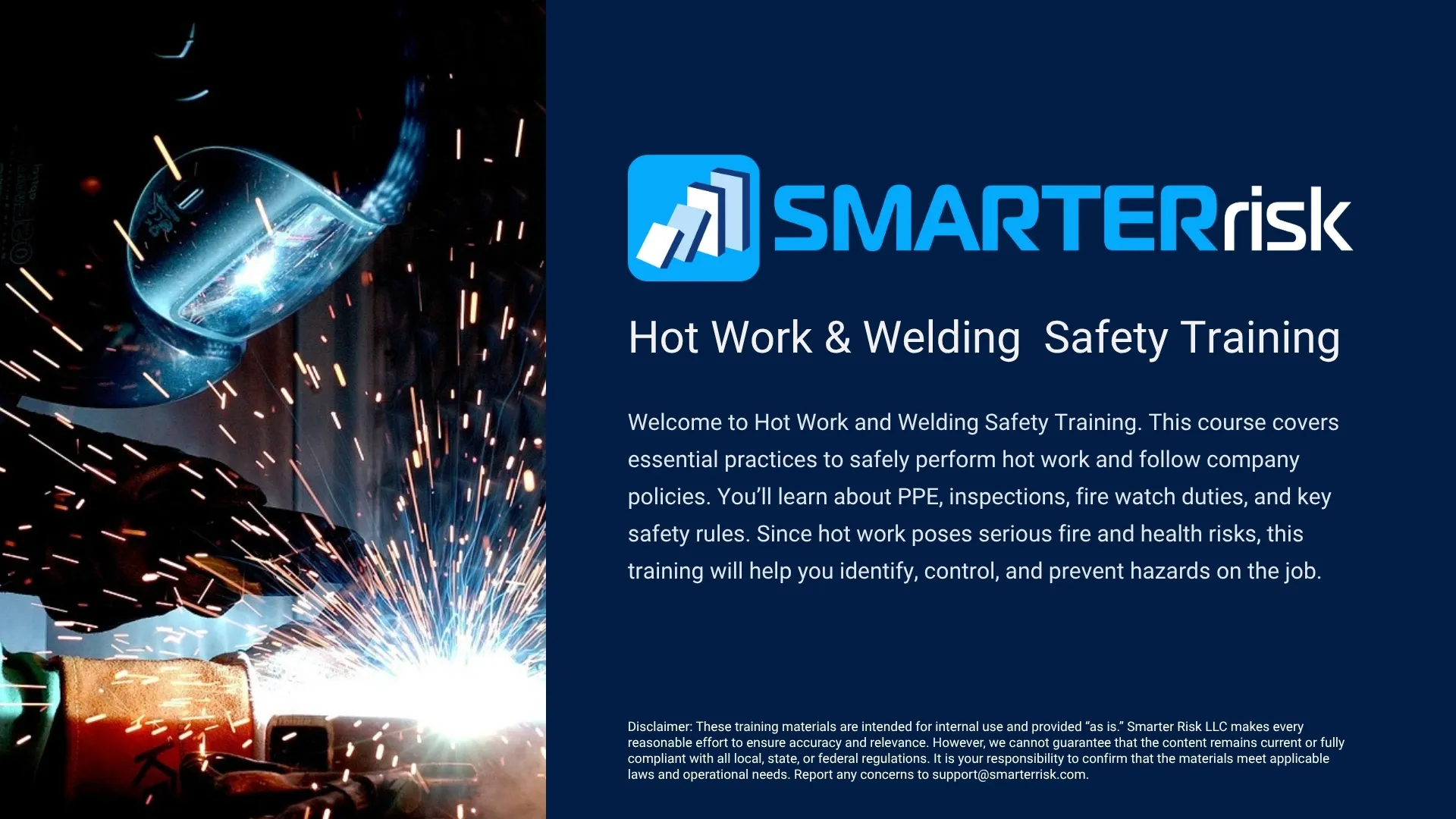
This Hot Work & Welding Safety Training course provides employees with the essential knowledge required to safely perform hot work operations in the workplace. The training focuses on hot work safety, fire prevention, hazard recognition, and the controls required when performing welding, cutting, grinding, brazing, and other hot work activities that can create ignition sources.
Employees learn what qualifies as hot work, common hot work hazards, and when hot work permits are required. The course explains permit conditions, site inspections, combustible material clearance, fire watch responsibilities, and post-work monitoring requirements. It also covers required hot work PPE, fire prevention practices, and ventilation controls—particularly when working with toxic metals or in confined spaces.
This training provides employees with a clear understanding of hot work safety requirements, including hazard recognition, fire prevention measures, hot work PPE, fire watch responsibilities, and ventilation controls. Employees learn what must be in place before, during, and after hot work to prevent fires, injuries, and hazardous exposures. This course does not teach welding techniques or trade skills.
This course is intended for employees who perform, supervise, or approve hot work and is designed to support safe, consistent hot work practices while reducing fire risk, injuries, and operational disruptions. This training is designed to help organizations meet OSHA requirements for workplace safety and supports compliance with OSHA 29 CFR 1910.252 and NFPA 51B hot work standards. Employers are responsible for ensuring site-specific procedures, hands-on instruction, and any additional requirements applicable to their operations are met.
What You’ll Learn
- What activities are considered hot work and why they present fire and safety hazards
- Common hot work hazards, including fire, explosion, fumes, burns, and radiation exposure
- When hot work permits are required and how the permit process works
- Fire prevention measures, including combustible material clearance and shielding
- Fire watch duties during hot work and required post-work monitoring
- Required hot work PPE for different operations
- Ventilation requirements for welding and cutting operations
- Additional controls required for confined space hot work
- When hot work must stop and permits must be voided
Course Details
Duration: 40 minutes
Format: Self Paced Online Training
Assessment: Knowledge quiz with immediate feedback
Certification: Certificate of completion upon passing
Access: Available 24/7 through Training Director LMS
Who Should Take This Course
- Employees who perform welding, cutting, grinding, brazing, or other hot work
- Maintenance personnel and trades working outside designated hot work areas
- Supervisors and managers responsible for overseeing hot work activities
- Employees authorized to approve or monitor hot work permits
- Contractors performing hot work on-site
Key Topics Covered
- Hot work definitions and hazard identification
- Hot work permit requirements and inspections
- Fire prevention and combustible material control
- Fire watch responsibilities and monitoring timeframes
- Personal protective equipment (PPE) for hot work
- Ventilation and exposure control for welding fumes and gases
- Compressed gas cylinder safety
- Arc welding safety fundamentals
- Confined space hot work requirements
- Contractor coordination and training requirements
IMPORTANT: This training must be combined with site-specific procedures, hands-on instruction for welding equipment and techniques, hot work permit system implementation, and all applicable federal, state, and local regulations specific to your facility and operations.
Frequently Asked Questions
How long does the training take?
The course takes approximately 40 minutes to complete. Employees can pause and resume at their convenience.
Is this training OSHA compliant?
This training is designed to help organizations meet OSHA requirements for workplace safety. It covers OSHA 29 CFR 1910.252 (Welding, Cutting, and Brazing) requirements and aligns with NFPA 51B hot work standards. The course provides the knowledge component of hot work safety training and should be supplemented with hands-on instruction, site-specific procedures, and hot work permit system implementation as required by your operations.
Do employees receive a certificate?
Yes. Upon successful completion, employees can generate a certificate of completion. All progress is stored and can be accessed in the main dashboard under Learner Report.
How often should employees take this training?
We recommend annual refresher training for all employees who perform or supervise hot work operations. Additional training is required when new hot work procedures are implemented, when employees change job assignments involving hot work, or when unsafe hot work practices are observed.
Can we track completion?
Yes. Training Director provides real-time tracking of assignments, completion status, and quiz scores, making it easy to verify that all employees have completed their hot work safety training.
What are hot work permit requirements?
Hot work permits are required whenever welding, cutting, grinding, or other hot work is performed outside designated hot work areas. Hot work permit requirements include site inspection, combustible material removal or protection, fire watch assignment, fire extinguisher placement, and authorization signatures. The permit must remain at the work site and be voided if conditions change or work is interrupted.
What are fire watch responsibilities?
Fire watch responsibilities are a critical component of hot work safety. Fire watch responsibilities include watching for fires or smoldering materials, knowing how to use fire extinguishers, having authority to stop work if unsafe conditions develop, and immediately reporting any fires hazards.
What PPE is required for hot work?
The training covers hot work PPE requirements for different operations. Required hot work PPE typically includes welding helmets, flame-resistant clothing, leather gloves and sleeves, safety glasses with side shields, steel-toe boots, and respiratory protection when required.
Does this training cover confined space hot work?
Yes. The course addresses confined space hot work requirements, including the need for additional ventilation, an attendant, communication controls, and compliance with permit-required confined space procedures. It explains why confined space hot work presents elevated risks due to limited ventilation, potential fume or gas accumulation, and restricted entry and exit.
However, this course does not provide hands-on confined space entry, atmospheric testing, or rescue training. Those elements must be addressed through a dedicated confined space entry program and site-specific procedures and training.
What is NFPA 51B and why does it matter?
NFPA 51B is the Standard for Fire Prevention During Welding, Cutting, and Other Hot Work. The training aligns with NFPA 51B hot work standards including permit requirements, fire watch duties, combustible material clearance distances, and post-work monitoring.
What if we don’t have a hot work policy?
You can quickly build one using Smarter Risk’s policy builder. The policy builder guides you through creating a comprehensive hot work policy that covers permit requirements, fire watch procedures, PPE requirements, and all essential safety controls. It takes less than 15 minutes and generates a customized policy ready for implementation.
Get Started
Hot Work & Welding Safety Training is included with the Intelligent Plan.
- Sign up - You can begin on the free plan and upgrade when you’re ready to assign courses.
- Complete the company risk assessment (required) - It takes less than 15 minutes. Answer all questions as accurately as possible so we can set up your account correctly.
- Access your dashboard - After submitting the assessment, you’ll be redirected to your dashboard.
- Click Training Director - Start assigning courses to your team.
Related Resources
Related Training Courses
- Fire Safety and Fire Extinguisher Training - Fire safety fundamentals including fire extinguisher use and emergency response
- Confined Space Safety Training - Confined space entry procedures including hot work in confined spaces
- Respiratory Protection Training - Respiratory protection for welding fumes and toxic exposures
Related Blog Posts
- Hot Works Policy: Why Every Company Needs One — and How to Build It Fast - Complete guide to building an effective hot works policy and permit system
- Fire Safety: Your Firewall Against Workplace Fires - Comprehensive fire prevention program including hot work fire prevention
Related Toolbox Talks
- Fire Watch Responsibilities During Hot Work - Essential fire watch duties and monitoring requirements
- Welding Cutting and Brazing Safety - Hot work safety fundamentals and best practices
- Fire Safety Basics: Workplace Fire Prevention and Emergency Response - Fire prevention strategies including hot work fire safety