MEWP Safety Training - Mobile Elevating Work Platform Training
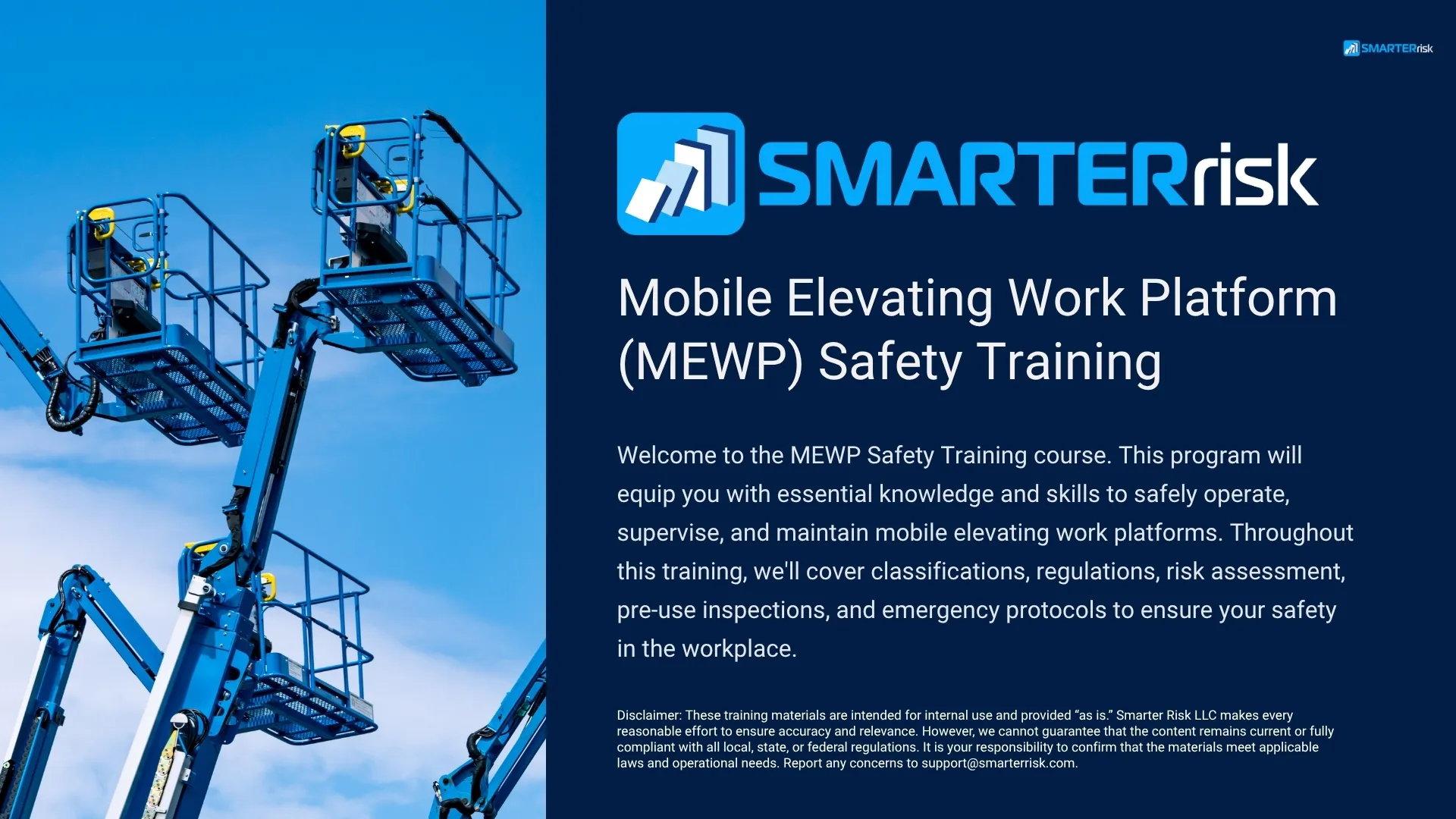
Mobile Elevating Work Platform (MEWP) Safety Training provides employees and supervisors with a clear understanding of how to safely operate MEWPs (formerly referred to as AWPs or aerial work platforms) in real-world jobsite conditions. The course focuses on recognizing common hazards, understanding equipment classifications, and applying required safety controls to reduce the risk of falls, tip-overs, electrocution, and other serious incidents.
The training covers MEWP classifications and limitations, pre-use inspection requirements, safe use planning, fall protection responsibilities, and emergency procedures. It emphasizes what must be in place before and during MEWP operation, including risk assessment, proper equipment selection, and coordination between operators, occupants, and supervisors.
This course is designed to support workplace safety programs by delivering the knowledge and awareness required for safe MEWP operation. It does not replace hands-on practical training, equipment-specific familiarization, or employer authorization, which are required before employees operate MEWPs in the field.
This course provides the knowledge and awareness portion of MEWP safety training. OSHA and ANSI standards require employers to also provide hands-on practical training, equipment-specific familiarization, and employer authorization before employees operate MEWPs in the field.
What You’ll Learn
- MEWP Fundamentals - What a MEWP is and how it is used in the workplace
- Equipment Classifications - MEWP classifications, including Group A / Group B and Type 1 / 2 / 3
- Hazard Recognition - Common MEWP hazards and how incidents occur
- Pre-Use Inspections - Pre-use inspection requirements and inspection frequency
- Safe Use Planning - Safe use planning, job hazard analysis, and risk assessment basics
- Fall Protection Systems - Fall protection requirements, including fall restraint vs. fall arrest
- Roles & Responsibilities - Operator, occupant, and supervisor responsibilities
- Emergency Procedures - Emergency procedures, rescue planning, and emergency lowering
- ANSI Standards - ANSI A92.22 safe-use principles and ANSI A92.24 training requirements
- OSHA Considerations - OSHA general industry and construction considerations
Course Details
Duration: 50 minutes
Format: Self Paced Online Training
Assessment: Knowledge quiz with immediate feedback
Certification: Certificate of completion upon passing
Access: Available 24/7 through Training Director LMS
Who Should Take This Course
- MEWP and aerial lift operators
- Scissor lift and boom lift users
- Supervisors overseeing work at height
- Safety managers and competent persons
- Employees who occupy or work around MEWPs
- Maintenance, facilities, warehouse, and construction-adjacent workers
Key Topics Covered
- MEWP (formerly AWP / Aerial Work Platform) definitions
- ANSI A92.22 safe-use principles
- ANSI A92.24 training responsibility requirements
- OSHA general industry and construction considerations
- Hazard identification and control measures
- Fall protection systems and harness use
- Inspection, documentation, and recordkeeping expectations
- Emergency response and rescue planning
Key Regulations Covered
This training addresses compliance requirements from:
- ANSI A92.22 - Safe Use of Mobile Elevating Work Platforms
- ANSI A92.24 - Training Requirements for the Use of Mobile Elevating Work Platforms
Frequently Asked Questions
How long does the training take?
The course takes approximately 50 minutes to complete. Employees can complete the training in one session or break it into multiple sessions at their convenience.
Is this training OSHA compliant?
This training is designed to help organizations meet OSHA requirements for workplace safety. It covers ANSI A92.22 and ANSI A92.24 requirements for MEWP safe use, training, and operator responsibilities. The training supports employer compliance with OSHA’s General Duty Clause and industry standards for aerial work platform safety. Employers are responsible for ensuring hands-on practical training, equipment-specific familiarization, and formal authorization before employees operate MEWPs. This training provides foundational knowledge but does not replace hands-on instruction or equipment-specific training required by ANSI standards.
Do employees receive a certificate?
Yes. Upon successful completion, employees can generate a certificate of completion. All progress is stored and accessible in the main dashboard under Learner Report.
How often should employees take this training?
ANSI A92.24 requires retraining when there is a change in equipment type, workplace conditions, or when an evaluation reveals inadequate knowledge. We recommend annual refresher training at minimum, with immediate training for new employees who will operate or work around MEWPs.
Can we track completion across our workforce?
Yes. Training Director provides real-time tracking of assignments, completion status, and quiz scores for all employees.
Does this training certify employees to operate MEWPs?
No. This training provides knowledge and awareness about MEWP safety, hazards, and safe-use principles. ANSI A92.24 requires employers to provide both knowledge-based training (like this course) and hands-on practical training with equipment-specific familiarization. Employers must evaluate operator proficiency and provide formal authorization before employees operate MEWPs.
What is the difference between MEWP and AWP?
MEWP (Mobile Elevating Work Platform) is the current industry standard term that encompasses a broader range of equipment including scissor lifts, boom lifts, vertical mast lifts, and other aerial work platforms. AWP (Aerial Work Platform) is an older term that has been largely replaced by MEWP in ANSI standards and industry practice. This training uses MEWP terminology to align with current ANSI standards.
What is the difference between fall restraint and fall arrest?
Fall restraint prevents a worker from reaching a fall hazard (e.g., guardrails on a scissor lift platform). Fall arrest stops a worker after a fall has occurred (e.g., a full-body harness and lanyard attached to an anchor point on a boom lift). Boom lifts (Group A MEWPs) typically require fall arrest systems, while scissor lifts (Group B MEWPs) typically use fall restraint through guardrails.
Get Started
MEWP Safety Training is included with the Intelligent Plan.
- Sign up - You can begin on the free plan and upgrade when you’re ready to assign courses.
- Complete the company risk assessment (required) - It takes less than 15 minutes. Answer all questions as accurately as possible so we can set up your account correctly.
- Access your dashboard - After submitting the assessment, you’ll be redirected to your dashboard.
- Click Training Director - Start assigning courses to your team.
Related Resources
Related Training Courses
- PPE - Personal Protective Equipment Safety - Covers fall protection equipment and proper PPE use for elevated work
- Ladder Safety Training - Safe practices for ladders and portable access equipment
- Job Hazard Analysis Training - Learn to identify and control elevated work hazards
- Confined Space Safety Training - Safety training for elevated and confined work environments
Related Blog Posts
- Top 10 OSHA Violations: Compliance Guide and Prevention Strategies - OSHA’s most cited violations including fall protection and aerial lift safety
- Slip and Fall Risk: Proven Strategies to Prevent Workplace Accidents - Comprehensive fall prevention strategies and workplace safety best practices
Related Toolbox Talks
- Aerial Lift Safety Basics: Preventing Falls and Electrocution Hazards - Essential aerial lift safety including fall protection and electrical hazards
- Scissor Lift Safety Tips: Preventing Tip-Overs and Falls from Elevated Platforms - Essential scissor lift safety including fall protection and safe operation
- Fall Prevention Strategies - Comprehensive fall protection strategies for elevated work