Overhead Crane Safety Training
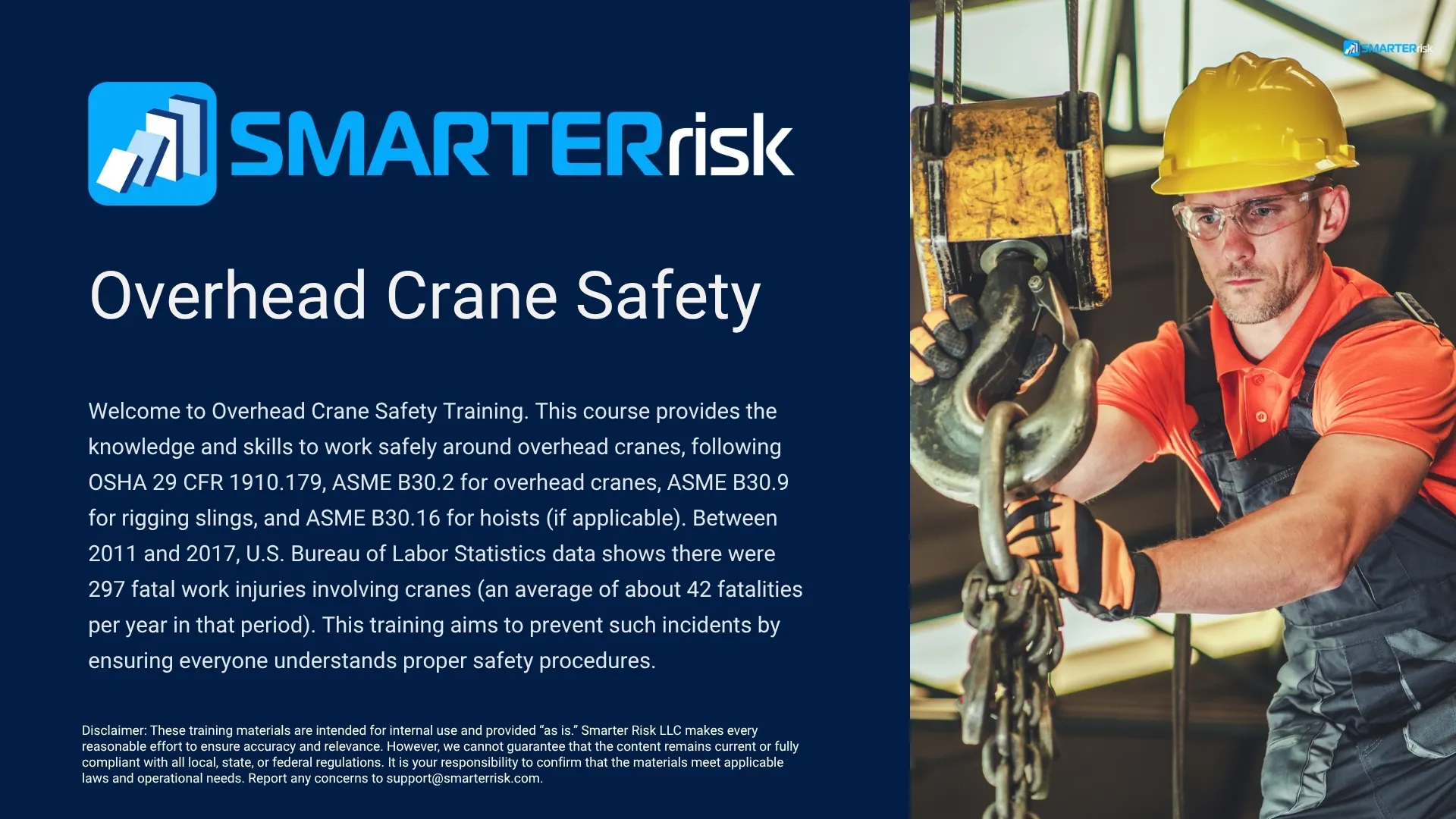
This Overhead Crane Safety Training course helps employees understand the safety requirements, hazards, and safe work practices involved in working with or around overhead cranes. The training focuses on accident prevention, hazard recognition, inspection awareness, and safe load-handling principles commonly encountered in industrial, manufacturing, warehouse, and shop environments.
The course explains how overhead crane incidents can occur and how to prevent them, including struck-by hazards, dropped loads, side pulling, improper rigging, equipment defects, and clearance violations. Employees learn why these conditions are dangerous and the importance of maintaining safe distances, recognizing unsafe conditions, and following established procedures to reduce the risk of injury, equipment damage, and operational downtime.
This training applies to common overhead crane types, including bridge cranes, gantry cranes, jib cranes, and monorail cranes. It focuses on safety responsibilities, required controls, and safe work behaviors for employees working with or around crane systems.
This training does not teach crane operation as a skilled trade or provide hands-on operator certification. Employers must provide equipment-specific training, hands-on instruction, and formal authorization before employees operate overhead cranes. This course provides foundational safety knowledge to support employer safety programs.
What You’ll Learn
- Crane Hazards - Common overhead crane hazards and how crane accidents occur
- Safety Responsibilities - Operator, rigger, signal person, and employer safety responsibilities
- Inspection Awareness - Overhead crane inspection frequency and inspection awareness
- Defect Recognition - Recognizing wire rope, hook, and rigging defects that require removal from service
- Safe Load Movement - Safe load movement practices, including avoiding side pulling and suspended load exposure
- Clearance Requirements - Clearance requirements and pinch-point hazards
- Communication Protocols - The role of hand signals and communication during crane operations
- Equipment Removal - When cranes must be removed from service and reported for repair
- Load Limits - Load capacity, load control, and safe lifting practices
- Lockout/Tagout - Lockout/tagout considerations during maintenance
Course Details
Duration: 40 minutes
Format: Self Paced Online Training
Assessment: Knowledge quiz with immediate feedback
Certification: Certificate of completion upon passing
Access: Available 24/7 through Training Director LMS
Who Should Take This Course
- Employees who operate overhead cranes
- Workers who rig loads or act as signal persons
- Maintenance and inspection personnel
- Supervisors overseeing crane operations
- Employees who work near overhead crane systems
- Safety coordinators in industrial, manufacturing, warehouse, or shop environments
Key Topics Covered
- Overhead crane safety fundamentals
- Types of overhead cranes and their applications (bridge cranes, gantry cranes, jib cranes, monorail cranes)
- Crane components and safety features
- Pre-use, frequent, and periodic inspection requirements
- Wire rope abnormalities and rigging rejection criteria
- Load limits, load control, and safe lifting practices
- Hand signals and communication protocols
- Lockout/tagout considerations during maintenance
- Incident prevention and safe work practices
- Struck-by hazards and dropped load prevention
- Side pulling hazards and clearance violations
Key Regulations Covered
This training addresses compliance requirements from:
- OSHA 29 CFR 1910.179 - Overhead and Gantry Cranes
Frequently Asked Questions
How long does the training take?
The course takes approximately 40 minutes to complete. Employees can complete the training in one session or break it into multiple sessions at their convenience.
Is this training OSHA compliant?
This training is designed to help organizations meet OSHA requirements for workplace safety. It covers OSHA 29 CFR 1910.179 requirements for overhead crane safety, inspection awareness, and safe work practices. The training supports employer compliance with OSHA overhead crane standards. Employers are responsible for ensuring equipment-specific training, hands-on instruction, operator evaluations, and any additional requirements applicable to their operations and equipment are met. This training provides foundational knowledge but does not certify operators or replace hands-on instruction required by OSHA.
Do employees receive a certificate?
Yes. Upon successful completion, employees can generate a certificate of completion. All progress is stored and accessible in the main dashboard under Learner Report.
How often should employees take this training?
OSHA requires retraining when there is a change in equipment, workplace conditions, or when an evaluation reveals inadequate knowledge. We recommend annual refresher training at minimum, with immediate training for new employees who will operate or work around overhead cranes.
Can we track completion across our workforce?
Yes. Training Director provides real-time tracking of assignments, completion status, and quiz scores for all employees.
Does this training certify employees to operate overhead cranes?
No. This training provides safety awareness and foundational knowledge about overhead crane hazards and safe work practices. OSHA 29 CFR 1910.179 requires employers to provide equipment-specific training, hands-on instruction, and operator evaluation. Employers must supplement this training with hands-on instruction and formal authorization before employees operate overhead cranes.
What types of overhead cranes does this training cover?
This training covers common overhead crane types including bridge cranes (overhead traveling cranes), gantry cranes, jib cranes, and monorail cranes. The safety principles apply across these crane types, but employers must provide equipment-specific training for the specific cranes employees will operate.
What are the most common overhead crane hazards?
The most common overhead crane hazards include struck-by incidents from moving loads or crane components, dropped loads from rigging failures or equipment defects, side pulling that can cause load swings or crane tip-overs, pinch points between loads and structures, and clearance violations. This training teaches employees how to recognize and prevent these hazards.
Get Started
Overhead Crane Safety Training is included with the Intelligent Plan.
- Sign up - You can begin on the free plan and upgrade when you’re ready to assign courses.
- Complete the company risk assessment (required) - It takes less than 15 minutes. Answer all questions as accurately as possible so we can set up your account correctly.
- Access your dashboard - After submitting the assessment, you’ll be redirected to your dashboard.
- Click Training Director - Start assigning courses to your team.
Related Resources
Related Training Courses
- Lockout/Tagout (LOTO) Safety Training - Essential LOTO procedures for crane maintenance and repair
- PPE - Personal Protective Equipment Safety - Proper PPE use for crane operations and rigging work
- Job Hazard Analysis Training - Learn to identify and control crane operation hazards
- Machine Guarding Safety Training - Machine safety including equipment guarding and lockout requirements
Related Blog Posts
- Ergonomics and Safe Lifting: Preventing Musculoskeletal Injuries - Ergonomic principles and safe lifting techniques including mechanical aids
- Top 10 OSHA Violations: Compliance Guide and Prevention Strategies - OSHA’s most cited violations including equipment safety and hazard communication
Related Toolbox Talks
- Safe Material Handling - Essential material handling safety including proper lifting and mechanical aid use
- Preventing Back Injuries: Spine Protection and Lifting Safety - Back injury prevention through proper lifting techniques and mechanical aids
- Lockout/Tagout Procedures: Essential Energy Control Safety - Critical LOTO safety procedures for crane maintenance